Period Poverty in America: The 2026 Picture
17 July, 2026

Period Poverty in America: The 2026 Picture
Period poverty. What does it mean? It’s the inability to access menstrual products, adequate sanitation, or menstrual health education due to financial or systemic barriers. It affects far more Americans than most people realize.
According to the Period Poverty Institute of America, new national data confirms that 41.9% of women in the United States have struggled at some point to access basic menstrual products. That’s nearly two in five. In a country with the resources of the United States, that figure demands attention.
This is the 2026 picture: who is most affected by period poverty in the USA, what the data tells us, how legislation is responding, and what businesses, schools, and organizations can do to be part of the solution.
The scale of the problem
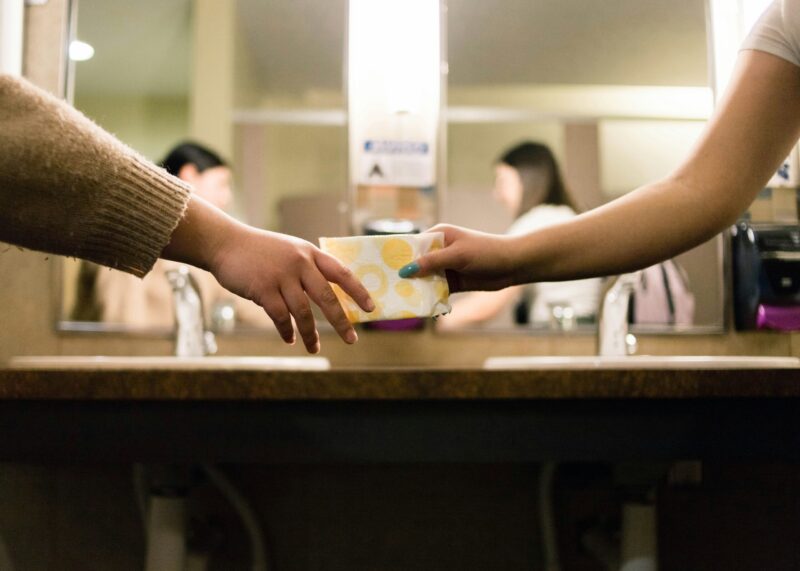
The numbers are stark. A 2025 survey by PERIOD. and Thinx found that nearly 1 in 4 teenagers who menstruate in the US experienced period poverty, which is up slightly from 2023. The same survey found that 45% of teens surveyed had worn period products longer than recommended, a direct consequence of not being able to afford adequate supplies.
For adults, the picture is equally sobering. A groundbreaking St. Louis study cited by Brookings found that 64% of low-income women were unable to afford period products at least once in the previous 12 months. A separate study found that 16.9 million menstruating women in the US live in poverty, with two-thirds classified as low-income and food-insecure. Period poverty is also associated with higher rates of depression: research has found that those experiencing monthly period poverty are at the greatest risk of symptoms consistent with moderate to severe depression.
These aren’t abstract statistics. They represent people going to school, to work, and navigating public spaces while managing a basic biological need without adequate support.

Who is most affected?
Period poverty does not affect everyone equally. Research consistently shows that certain groups face compounding barriers:
Low-income individuals and families
Federal food assistance programs like SNAP do not cover menstrual products, leaving many low-income households to choose between period supplies and other essentials. A 2025 analysis in the Journal of Global Health Economics and Policy describes this as part of a vicious cycle in which period poverty worsens economic outcomes over time.
People experiencing homelessness
For the over 210,000 women experiencing homelessness in the US, managing a period without shelter, private facilities, or reliable access to products presents an ongoing, monthly crisis. Many shelters lack the resources to provide more than a few items per cycle.
Incarcerated individuals
The American College of Physicians notes that access to period products in correctional settings remains inconsistent across the US, despite 25 states now having laws requiring free period products for incarcerated women.
Students in under-resourced schools
The Brookings analysis emphasizes that period poverty “knows no boundaries”, affecting students in rural areas, small towns, and major cities alike. School nurses in both urban and rural Missouri were equally likely to report students missing school due to their periods.
Black and brown communities
Research highlights that period poverty reflects and reinforces broader patterns of racial and socioeconomic inequality in the US, with Black and brown menstruators disproportionately affected.
What’s changing: the legislative landscape in 2026
The policy response to menstrual equity in the US has accelerated significantly. As of 2026, according to the American College of Physicians’ Advocacy Toolkit:
- 28 states and Washington D.C. have passed laws requiring free menstrual products in schools
- 25 states have laws requiring free period products for incarcerated women
- 3 states require period products to be available at no cost in homeless shelters
At the federal level, the Menstrual Equity for All Act (reintroduced in 2025) would, if passed, extend free period product requirements to federal buildings, large employers, college campuses, homeless shelters, and correctional facilities, while also directing Medicaid to cover menstrual products.
The trend is clear: period equity is moving from advocacy agenda to legal mandate. For organizations in the school, business, government, and nonprofit sectors, this is the time to get ahead of it.

The role of businesses and organizations
Legislation sets the floor. But for businesses, schools, and nonprofits that genuinely want to address period poverty, the ceiling is much higher and some of the most impactful steps don’t require a law to mandate them.
For CSR and ESG leads, menstrual equity is an increasingly visible component of workplace inclusion and gender equity reporting. Organizations that can demonstrate they’ve taken practical steps, providing free products in workplace restrooms, equipping facilities with proper sanitary disposal units, supporting community organizations working on period poverty, are demonstrating a credible commitment to the people they employ and the communities they operate in.
For schools and nonprofits, the connection is even more direct. Every student who doesn’t have to choose between attending class and managing their period is a win for educational equity. Every shelter resident who has access to products and proper sanitary disposal facilities has one less indignity to navigate.
Practical Steps: Where to start
Whether you’re a school administrator, an HR lead, a facilities manager, or a nonprofit director, here are concrete starting points:
Provide free period products in restrooms
In schools, workplaces, shelters, and public buildings. The Menstrual Equity for All Act framework is a useful benchmark for what ‘good’ looks like, even before it becomes law.
Equip every restroom stall with a proper sanitary unit
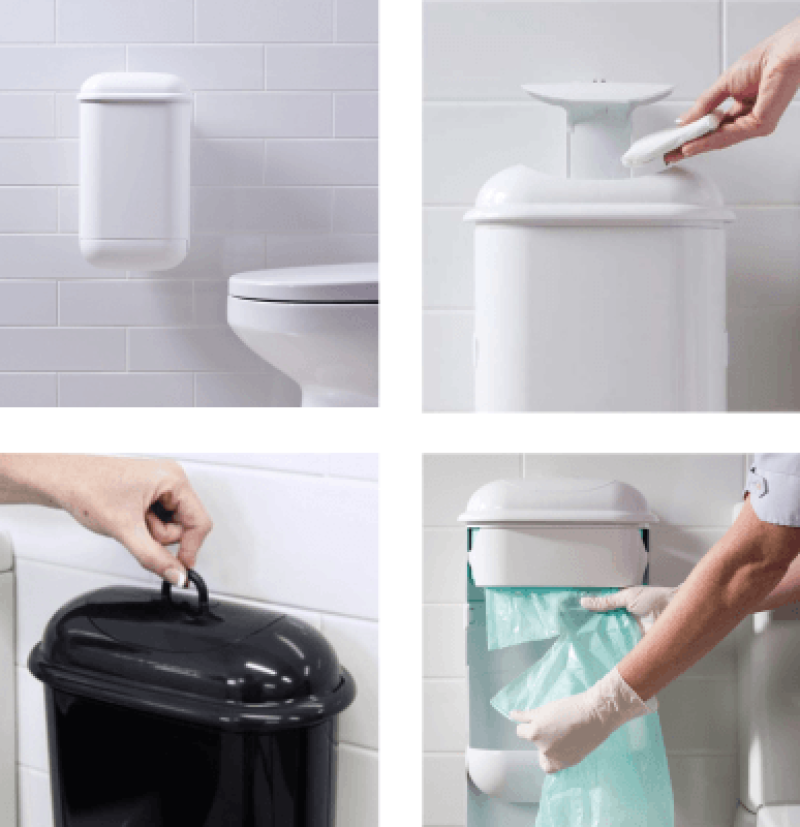
Access to period products without a hygienic disposal option is only half the solution. Purpose-built sanitary disposal units in every stall ensure the full cycle of dignified period management is supported.
Partner with local period poverty organizations
Groups like PERIOD., the Alliance for Period Supplies, and local food banks often run product donation drives that organizations can support with in-kind contributions or fundraising.
Include menstrual health in your DEI or wellbeing strategy
Period poverty is a gender equity issue and a health equity issue. Naming it explicitly in organizational strategy signals that your commitment to inclusion extends to this often-overlooked area.
Advocate
Support state and federal legislation that advances menstrual equity, and consider signing organizational statements in support of the Menstrual Equity for All Act.
The Bottom Line
Period poverty in America is not a niche issue. It’s a public health problem, an education equity problem, and a workplace dignity problem that affects tens of millions of people. The legislative momentum of 2025 and 2026 is encouraging, but laws alone won’t close the gap. It takes institutions, businesses, and communities making active choices to do better.
The good news is that some of those choices are remarkably simple. Stocking a restroom with period products. Ensuring every stall has a proper sanitary disposal unit. Making it easy for someone to manage their period at school or work without stress, without embarrassment, and without missing a beat.
SaniPod™ USA works with educational facilities, workplaces, and building owners and managers across the country to provide hygienic, discreet sanitary disposal solutions that support menstrual dignity every day.
Explore our full range and take one of the simplest steps toward period equity today.
Talk to us about how our SaniPod™ sanitary units can transform your restroom
Get in touchProudly used by


