Heavy Periods at Work and How to Manage Them
28 September, 2026

Heavy Periods at Work and How to Manage Them
The 9 a.m. meeting is starting. You’re wearing a super tampon and a pad together and doing the math on whether they’ll hold until the 10:30 break. Nobody at the table knows, and you’d like to keep it that way.
Search for “heavy period” in the US, and you mostly get hospital pages about diagnosis. Those matter. What they don’t cover is managing a heavy period at work, which is where most of us have to deal with it. This piece starts there: what counts as heavy, how to get through the day, and what your employer can change. We’ve written before about how companies can support menstrual health in the workplace, and this is the version for the person living it.
Heavy menstrual bleeding has a clinical name, menorrhagia, and a definition specific enough to measure yourself against. It’s also common. The CDC (U.S. Centers for Disease Control and Prevention) puts it at more than 10 million American women a year, or about one in five. If you’ve ever wondered whether yours counts, keep reading.

What counts as a heavy period?
The CDC’s line is the simplest: periods lasting more than 7 days, or needing a new tampon or pad in under 2 hours, count as heavy. The Mayo Clinic adds the signs people recognize from experience. Soaking through one or more pads or tampons every hour for several hours in a row. Needing double protection. Waking at night to change. Passing clots larger than a quarter. Feeling tired, weak or short of breath.
Those signs are worth taking to a clinician, because heavy bleeding has causes that need a diagnosis. The Mayo Clinic lists hormonal causes, fibroids and polyps, and bleeding disorders among them. That last one is under-recognized. A 2026 Lancet Haematology commission, led by a Cleveland Clinic hematologist, found women wait an average of 14 to 16 years for a bleeding disorder diagnosis. Men wait about two years.
If your periods have always been like this, raise it with a doctor.

Getting through the workday
None of the below replaces a doctor. All of it makes Tuesday easier.
Plan the day around your flow
You know which days are heaviest. Where you have a say, put the flexible work there and keep the all-day offsite for later in the cycle. Keep a change kit at your desk and another in your bag: period products, wipes, a spare pair of underwear, a bag for the used ones.
Double up and know your change times
Use pads made for heavy flow, or period underwear as a backup layer under a tampon, whichever works for your body. On a heavy day, the urge to change tends to arrive after you already needed to, so set an interval and stick to it. Put a quiet reminder in your calendar and treat it like any other appointment. Leaving a tampon in past the interval on the pack also raises the risk of toxic shock syndrome, which our guide to covers in full.
What to keep at work in case of a leak
Leaks happen on heavy days to everyone who has them. Keep a spare outfit or a dark layer at work. Know where the nearest well-stocked restroom is before you need it.
The signs that need a doctor
Dizziness, breathlessness, exhaustion and a racing heart can be signs of anemia from blood loss. A period that soaks through protection every hour for several hours in a row is a reason to seek care that day, per the Mayo Clinic. Ask your clinician about the options. There are several, and that conversation belongs in an exam room.
Say as much or as little as you want
You don’t owe anyone the details. “I have a medical thing this week and may need to step out on short notice” is a complete sentence for a manager. If you have a diagnosed condition, you may also have protections. The FMLA gives eligible employees up to 12 weeks of unpaid, job-protected leave a year for a serious health condition, and it can be taken in short blocks rather than all at once. The ADA can require reasonable adjustments, a flexible schedule among them, where a condition substantially limits a major life activity. Whether either applies depends on your employer and your diagnosis, so ask HR. How easy that conversation feels depends a lot on the workplace, which is something we explored in a truly supportive workplace starts in the restroom.
What employers and office managers can change
If you run a workplace, three things change the day for the people who work in it.
- Stock every women’s and all-gender restroom with free period products, restocked on the facilities checklist the way soap and paper towels are. It’s a restroom supply, not a wellness perk. Our guide to free period products at work covers the cost and the rollout.
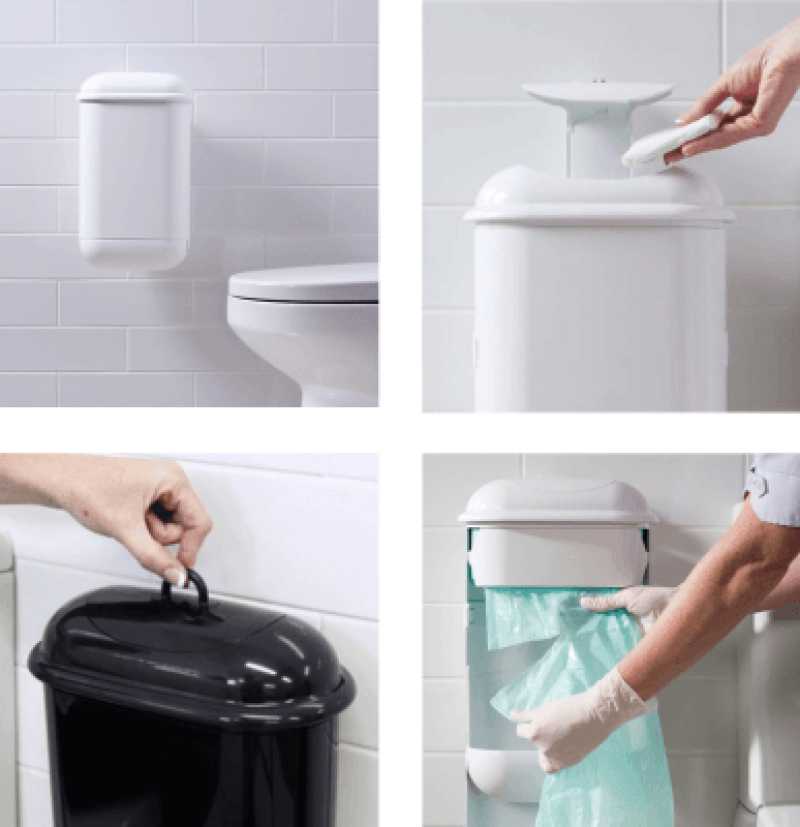
- Put a sanitary disposal unit in every stall. An 11 a.m. change should not mean carrying a wrapped pad past colleagues to the trash by the sinks. Wall-mounted, touch-free sanitary disposal units solve that quietly and hygienically. SaniPod’s Pod™ Petite Auto is a smart, easy and safe solution for menstruators. It uses a sealed liner cartridge, so custodians change a liner rather than handle waste. You can see how SaniPod™ units sit in a corporate restroom on our sanitary units for offices page, and the Pod™ Petite Auto page has the full specifications.
- Make stepping out normal. Build in flexible breaks and let people take them without explaining why.

Why the restroom is the real accommodation
Policies are written in HR. Dignity is delivered in the restroom stall.
A heavy period is a predictable, recurring reality for many employees, and most buildings are still not set up for it.
When the restroom has period products, a sanitary disposal unit in every stall and a door that closes, the person in the 9 a.m. meeting gets to think about the meeting.
Heavy periods at work: where to start
If you’re the one managing a heavy period at work, it’s common, and it’s worth a conversation with a doctor, especially if it has always been this way.
If you’re the employer, it comes down to period product access in the restroom, a sanitary unit in every stall, and breaks nobody has to justify.
Get in touch with our team to make every stall in your workplace ready.
Talk to us about how our SaniPod™ sanitary units can elevate your restroom
Get in touchProudly used by


