Setting Up Middle and High School Bathrooms for Menstruating Students
15 September, 2026

Setting Up Middle and High School Bathrooms for Menstruating Students
A seventh grader’s period starts in third period. The nearest restroom has a dispenser that ran empty last week and no sanitary unit in the stall. So she wraps the pad in a paper towel and carries it past a line of classmates to the trash by the sinks, hoping nobody looks.
She’s not the exception. As of early 2026, 27 states and Washington, D.C., have laws on free menstrual products in schools, and the list is still growing. Almost every one of them talks about period products. Almost none of them talk about the stall.
A period-ready school bathroom is one where a student can access a period product, use it, and dispose of it privately without leaving the stall or asking an adult. This guide is for the facilities lead, principal or school nurse who has been handed a mandate and a bathroom count, and wants to get school restroom period products right the first time.
If you want the wider context first, we covered it in period poverty in America.

Which states require free menstrual products in schools?
It depends on what you count. As of January 2026, the count was 27 states plus the District of Columbia, according to the menstrual equity nonprofit PERIOD. A 2025 legal scan of all 50 states and DC found 29 jurisdictions with laws supporting access, but only 24 that actually mandate provision. The rest fund it, permit it, or encourage it. The Alliance for Period Supplies keeps the state-by-state tracker current.
The details vary. Minnesota passed its law in the 2023 session and covers grades 4 to 12. Pennsylvania expanded its requirement in 2024 to every school with grades 6 to 12, and announced its first state grants in January 2025. New York City provides products in school buildings with grades 4 and above under city and state law. California’s threshold is public schools with grades 6 to 12 where at least 40% of students live below the poverty line. The full state-by-state breakdown, sorted by whether your state requires, permits or funds provision, is in our School Bathroom Setup Guide for K-12 Schools.
At the federal level, the Menstrual Equity for All Act (H.R. 3644) was reintroduced by Representative Grace Meng in May 2025 and is still in committee. If it passes, it would extend requirements further. Check your own state’s statute for the grade range and where products must be placed.
The five things a period-ready bathroom needs
Free products where students actually are
Free period product are required to be in the bathroom, where the need arises. A trip to the nurse’s office means a hall pass and ten minutes of class. Stock both pads and tampons, sized for the age group, and put restocking on the custodial checklist under a named role. A dispenser nobody owns is a dispenser that runs empty.
A sanitary disposal unit in every stall
Sanitary waste disposal is the other half of the job. A student who can get a pad but has nowhere private to put the used one is back to paper towels and the walk to the sinks.
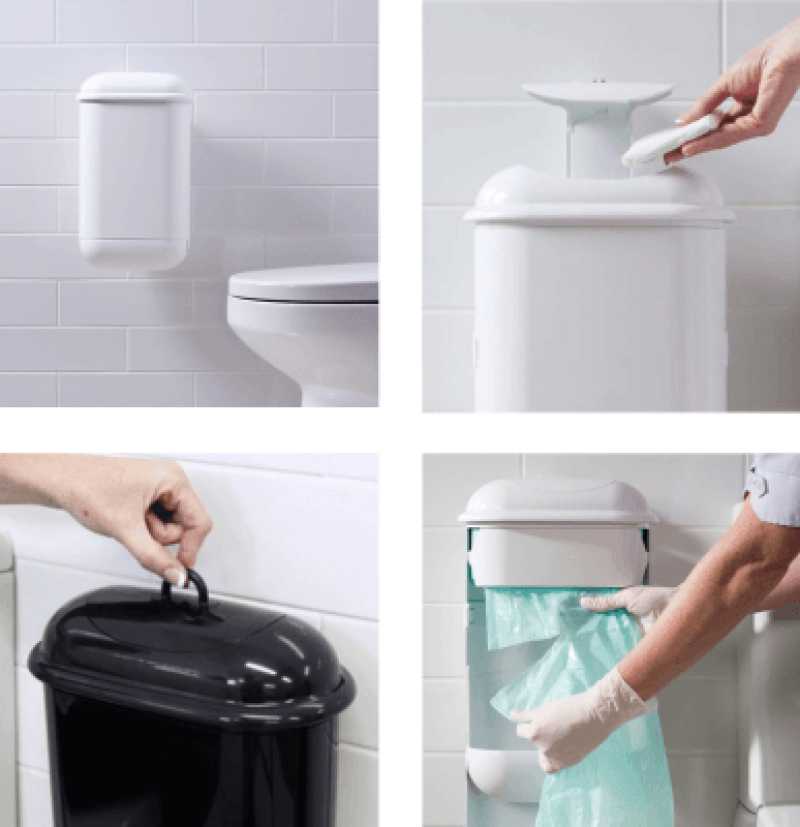
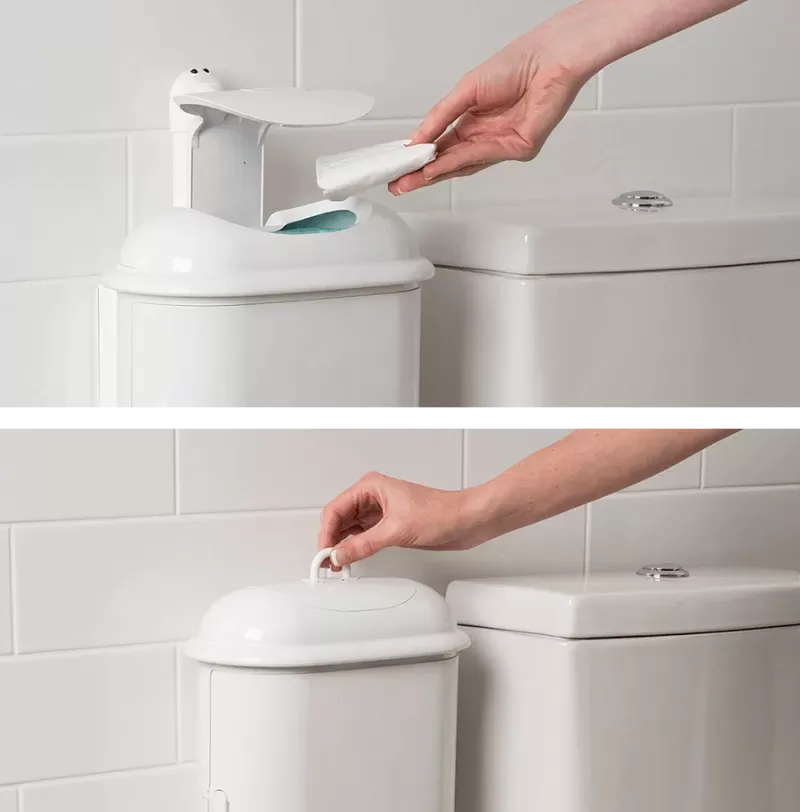
Wall-mounted, touch-free units keep floors clear and let students dispose of period products without leaving the stall. SaniPod’s Pod™ Petite Auto is compact enough for a school stall, and its sealed liner cartridge means custodians change a liner rather than handle waste. It holds up to 26 liners and lasts roughly six to nine months in typical use, with a 1.8-gallon (7 L) capacity. Our sanitary units for education facilities page shows how schools set SaniPod™ units up, and the Pod™ Petite Auto page has the specifications.
Gender-neutral and accessible bathrooms too
Students who menstruate use all-gender and accessible bathrooms, and those stalls need period products and sanitary disposal units as well. Wall-mounted units suit accessible layouts because they keep floor space clear for mobility aids. Our post on ADA compliance for restrooms covers the layout side.
Signage that informs without embarrassing
Plain signs do the work. Students need to know where the period products are, what goes in the sanitary disposal unit, and what should never go in the toilet. Write it the way you’d write any other facilities notice. A sign that reads as a health class poster gets ignored; one that reads as the exit sign gets followed.
A servicing routine that matches the school day
Check sanitary disposal units and dispensers on a schedule tied to traffic, which in a school means the between-class rush. Waiting for a complaint means a student found the problem first. SaniPod’s sealed liners turn the check into a two-minute job, so it fits between bells.
Dignity is a design decision
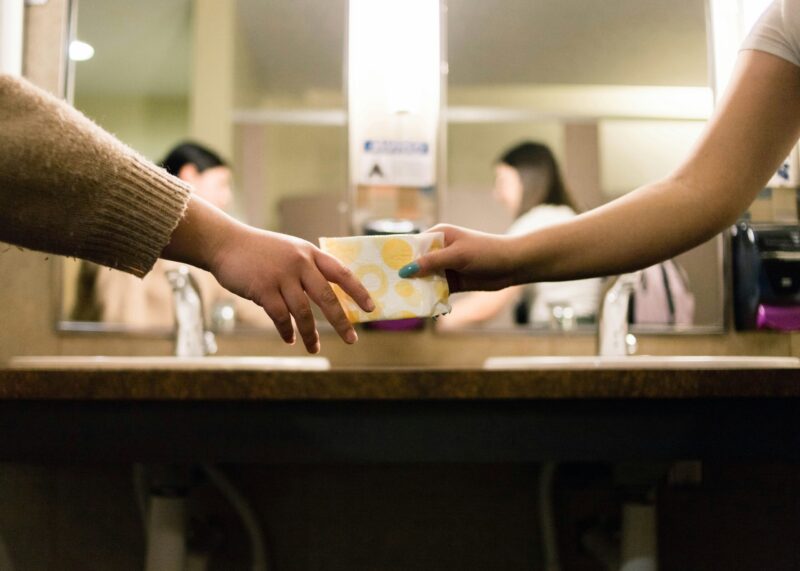
A bathroom that ignores a predictable, monthly event produces predictable, monthly results. Students miss class, lose focus, and get embarrassed for no reason. A 2023 statewide survey of Missouri school nurses, published in the Journal of School Health, found that around 68% knew students who had missed school because of their period. Close to 71% knew students who couldn’t afford products. The fix is rarely more compassion. It’s just a period product dispenser that’s full and a sanitary disposal unit that’s there for when students need it.

Paying for it: grants, budgets and what to ask
Grants for period products in schools exist, and they’re growing. Pennsylvania’s 2025 grants are a dated example of a state funding products directly. Nonprofits such as the Alliance for Period Supplies and PERIOD. list donation and grant routes for districts that have no state funding yet.
Sanitary disposal units sit in a different column. They usually belong to the facilities capital or maintenance budget rather than the health budget, which is why the facilities lead and the school nurse need to plan together. A period product dispenser bought from one budget and a sanitary disposal unit from another still have to end up in the same stall.
A 30-minute bathroom audit
You can do this before the end of the week.
- Count the stalls in every girls’, all-gender and accessible bathroom in the building.
- Note which stalls have a sanitary disposal unit and where the nearest period product dispenser is.
- Check the signage in each bathroom, or note that there isn’t any.
- Confirm who restocks products and service units, and how often.
- List the gaps by building and bring the list to the next facilities meeting.
That list is your compliance plan and, more to the point, a plan for a restroom students will actually use.
Start with the stall count
Most districts will meet their mandate by installing period product dispensers. The ones that get this right also put a sanitary disposal unit in every stall, because that’s where the rest of the job happens.
School restroom period products come down to two fixtures:
- a period product dispenser a student can easily access,
- a sanitary unit that is discrete and hygienic to safely dispose the sanitary waste within the stall
Get both in place and the seventh grader in third period gets on with her day.
Get in touch with our team to plan disposal for every stall in your district, or find your local supplier through our US distributor network.
Talk to us about how our SaniPod™ sanitary units can elevate your restroom
Get in touchProudly used by